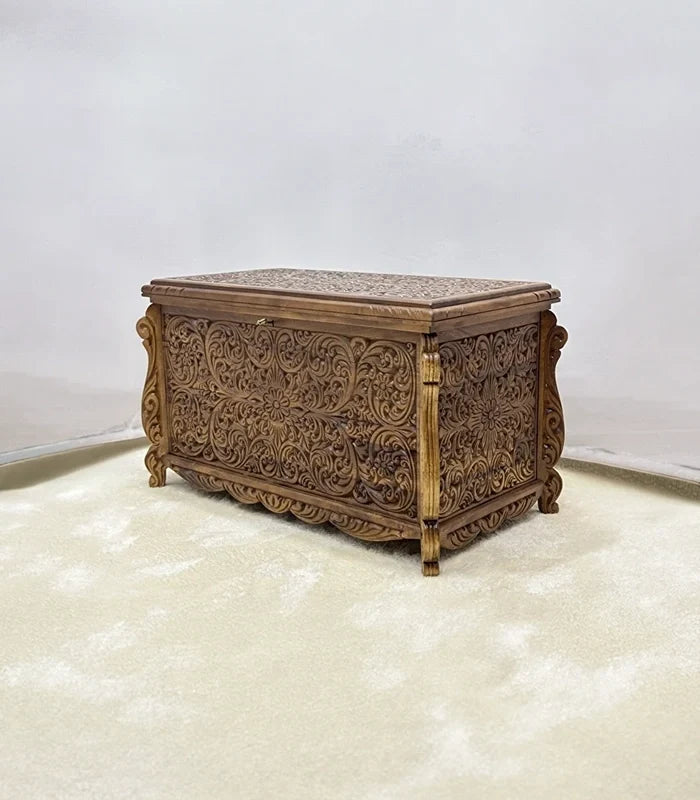
The Tree of Life and Other Anatolian Carving Motifs, Explained
What the Tree of Life, the daisy, the ivy, Ottoman florals and Seljuk ornament mean on hand-carved walnut from Kahramanmaraş, and how to choose and hang carved wooden wall art.
Hand-carved wooden wall art from Anatolia speaks in a small, old vocabulary of motifs. The Tree of Life (hayat ağacı) is usually read as life, continuity and family; the daisy (papatya), the climbing ivy (sarmaşık), Ottoman florals and Seljuk-style ornament each carry their own associations. Here is how to recognize them on carved walnut.
Every motif in this article appears on a piece in Edition II, the Maraş Edition: chests, wall shelves and calligraphy panels carved entirely by hand from solid walnut in Kahramanmaraş, a city in southeastern Türkiye known for its walnut carving. We will look at what each motif is, what it is commonly taken to mean, and how to choose and hang carved walnut so the work reads well on your wall or at the foot of your bed.
A word of honesty before we start. Folk motifs travel across centuries, regions and households, and their meanings shift as they go. What follows are the widely shared readings, not fixed definitions, and where an interpretation is uncertain we say so.
What does the Tree of Life mean in Anatolian carving?
The Tree of Life is most often read as a symbol of life itself and of its continuation: roots in the earth, a trunk that holds steady, branches reaching upward and outward. In Anatolian homes it is frequently linked to family and lineage, the idea that each generation grows from the one before.
The motif is far older and wider than any one culture. Versions of a sacred or cosmic tree appear across the ancient Near East, in Central Asian traditions, in Christian and Islamic art, and in the woven carpets and kilims of Anatolia. Some traditions read the tree as a bridge between the underworld, the earth and the sky; others connect it with abundance, fertility or the hope of immortality. All of these readings exist, and a carver in Kahramanmaraş today may hold any or none of them in mind as he works.

In carved walnut the tree is usually composed symmetrically, with a central trunk and branches mirrored on either side. That symmetry is part of its calm. On our domed Hayat Ağacı 95 chest, the catalog describes the tree as branches, leaves and roots carved across the front, so the whole life of the tree, below ground and above, is shown at once.
The motif appears on five Edition II chests, from the Hayat Ağacı 50 keepsake chest at 50 × 32 × 37 cm (19.7 × 12.6 × 14.6 in) to the full-size Hayat Ağacı 95. Because it is so closely tied to family, it is a natural choice for a wedding, a new home or a chest meant to be handed down. You can read more about that role in our story of the Anatolian sandık.
What is the papatya, or daisy, motif?
Papatya is the Turkish word for the daisy or chamomile flower, and as a carved motif it is a simple radiating flower: a round center with petals spreading evenly around it. It is one of the most approachable motifs in the Maraş vocabulary, cheerful rather than solemn.
Radiating flowers and rosettes are among the oldest ornaments in Anatolian stone and wood. Readings of the daisy itself are modest and vary: freshness, simplicity, innocence, the countryside in spring. We would not claim a deeper fixed symbolism for it, and we do not think it needs one. Its appeal is in repetition, a field of small flowers that catches light differently across the surface of the wood.


The Papatya 68 chest sets its daisies symmetrically across the front, in a Natural finish that shows the walnut's own color. The 50 cm keepsake version is sized for letters, photographs, jewelry and keepsakes, a good first piece if you are drawn to the pattern.
What does the sarmaşık, or ivy, motif symbolize?
Sarmaşık means ivy, and the carved motif is a climbing vine that winds continuously across the surface, leaves set along a curling stem. It is commonly associated with attachment, loyalty and endurance, because ivy clings to what it grows on and stays green through winter.
Those associations are shared by many cultures, not only Anatolian ones, so the ivy is easy for American households to read as well. As ornament, a continuous vine has a practical virtue: it leads the eye along the whole length of a piece instead of fixing it on one point. On a chest, that makes the front feel like a single composition rather than a set of panels.

The ivy runs across the lid and front of the Sarmaşık 50 keepsake chest, which comes in the Antique finish, and across the front of the larger Sarmaşık 68 and 95 chests.
How do you recognize Ottoman floral ornament?
Ottoman floral ornament is recognizable by its stylized garden flowers, curving stems and leaves, arranged with strong symmetry. In Ottoman court art, especially the well-known Iznik tiles and the textiles of the period, tulips, carnations, hyacinths and roses were favorite subjects.
On carved walnut, that language is translated into relief. Flowers become rounded forms raised from the background; stems become curves that balance each other left and right. We would not claim that every flower on a given chest is a tulip or a carnation, since carvers adapt and simplify freely, but the family resemblance is clear once you know to look for it.

Several Edition II pieces draw on this tradition. The Leyla 95 chest carries Ottoman-inspired floral motifs set symmetrically across the front. The İstanbul 95 is carved with Ottoman-inspired curves, the Meriç chests with symmetrical floral motifs and flowing, balanced curves, and the Seyyah folding chair with classic Ottoman-style carving on its backrest.
What are rumi motifs, and where do they come from?
Rumi is the name given in Turkish decorative art to a stylized, split-leaf or wing-like form that curls and interlocks in endless scrolls. The name is usually traced to Rum, the old name for Anatolia, and the motif is strongly associated with Seljuk-era ornament in the region, though it continued through Ottoman art.
Rumi forms are often paired with hatayi, stylized blossoms and buds. Together they make up much of the scrolling ornament seen on carved doors, book covers, tiles and woodwork across Türkiye. Unlike the Tree of Life or the daisy, a rumi form is not a picture of anything; it is pure rhythm, a way of filling space so the eye keeps moving.
We do not label individual chests as "rumi." Pieces our catalog describes as carrying dense traditional or Maraş motifs, such as the Aliye, Erva and Sultan chests, draw broadly on this world of scrolling, interlacing ornament, and each carver interprets it in his own hand. If you love this kind of all-over pattern, the full collection of hand-carved chests is the place to compare them side by side.
Which Seljuk and Ottoman architectural motifs appear in carved wood?
Architectural motifs borrow from the buildings of Anatolia: pointed and rounded arches, niches, rosettes, star-based geometric interlace and the stepped, honeycomb-like vaulting known as muqarnas. Seljuk portals and Ottoman mosques and fountains are the great reference points.
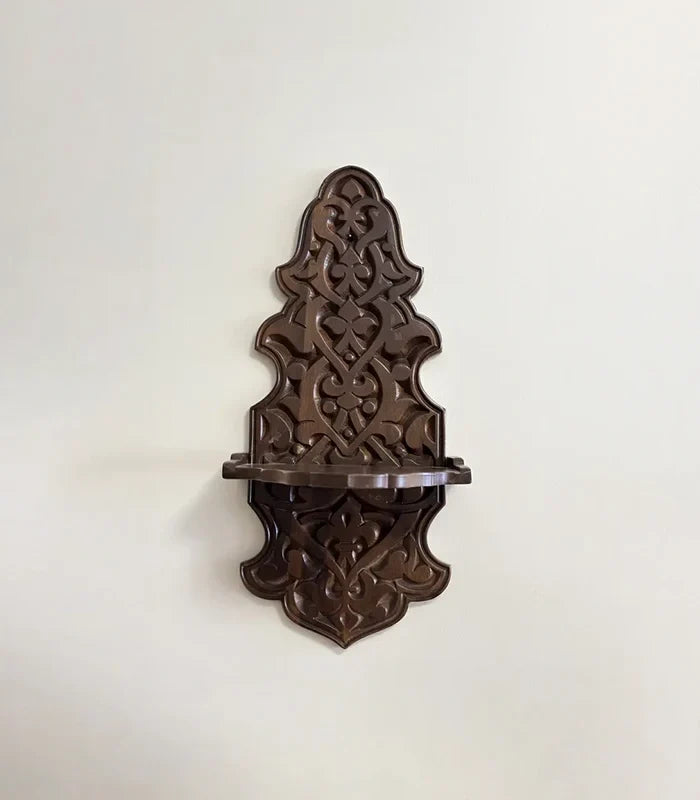
Translated into a wall piece, these forms give carved walnut a sense of structure. An arch frames, a rosette centers, a band of geometry anchors the edge. The two Kavukluk wall shelves are our clearest examples. A kavukluk was the carved wall shelf on which an Ottoman household kept its turbans and fez; today it holds hats, books, plants or a few treasured objects.
How do you choose wooden wall art with Anatolian motifs?
Choose wooden wall art by the job the wall needs to do: a shelf for a hallway where things get set down, a calligraphy set for a quiet room with a clear focal wall, or a carved surface that simply brings texture to a plain painted wall. Then match the scale to the wall and the motif to the mood of the room.
Our hand-carved walnut wall decor currently includes three pieces:

Kavukluk 66 — hand-carved walnut wall shelf
The larger Kavukluk, carved with motifs inspired by Ottoman and Seljuk ornament. It is wide enough to work above a console, a bench or a chest, holding hats, books or a few objects you want seen.
Hand-carved solid walnut · 66 × 30 × 25.5 cm (26 × 11.8 × 10 in), W × H × D · wall-mounted
See the Kavukluk 66
Kavukluk 44 — smaller hand-carved walnut wall shelf
Carved with classic Ottoman architectural motifs and sized for a hallway, a study or a reading corner. A good choice when the wall is narrow or you want carved texture without a large piece.
Hand-carved solid walnut · 44 × 21 × 17.5 cm (17.3 × 8.3 × 6.9 in), W × H × D · wall-mounted
See the Kavukluk 44
Hat Set — hand-carved walnut calligraphy panels
Hat is the Turkish word for the art of calligraphy. Three panels carved by hand: the Basmala above, with Allah and Muhammad on either side. A set for a room where you want the wall to hold meaning as well as beauty.
Hand-carved solid walnut · Basmala 60 × 26 cm (23.6 × 10.2 in) · two panels 40 × 40 cm (15.7 × 15.7 in)
See the Hat SetA few practical rules help. For a single shelf or panel, many designers aim for the center of the piece at roughly eye level, about 57 to 60 in from the floor, then adjust for furniture below. Above a console or chest, leave a gap of around 8 to 12 in so the two read as a pair rather than a stack. Hang a solid walnut shelf into studs or with anchors rated for its weight, and if you are unsure, ask a handyman to do it.
The walnut calligraphy panels are traditionally hung with care. Many households place religious calligraphy at or above eye level, in a living room, entry or study rather than a bathroom or kitchen, and keep the set together as a group. Follow your own family's custom if you have one.

Natural or Antique finish: which shows the motifs better?
The Antique finish shows motifs more dramatically; the Natural finish shows the walnut more honestly. Many Edition II pieces come in both, and the choice is about where the piece will live and what you want to notice first.
Antique, called eskitme in Turkish, is darkened by hand so the shadows in each cut deepen and the raised carving stands out. It suits dense patterns, low or warm lighting, and rooms with traditional furniture. Natural lets the walnut show its own warm color, which suits brighter rooms and simpler patterns such as the daisy or the ivy, where the grain becomes part of the design.

Light matters as much as finish. Carving is relief, so it reads best when light falls across it at an angle, from a window to one side or a lamp beside it. Straight-on light from the front flattens any carving.
How is the carving actually made?
Each piece is carved by hand with chisels from solid walnut in the workshops of Kahramanmaraş. The pattern on yours was made by a person, not a machine, so no two are exactly alike. Grain, color and the depth of each cut differ slightly from the photographs.
That variation is the point. A Tree of Life carved by hand will have a branch that leans a little more on one side, a leaf cut a fraction deeper. Over years, solid walnut also deepens and warms in color, so the piece keeps changing slowly.
To see the same craft applied to furniture you use every day, read our guide to choosing a walnut coffee table.
Browse all of Edition II, the Maraş Edition, to see these motifs across chests, tables, wall pieces and tesbih boxes in one place.
For a chest that carries these motifs at the foot of a bed, our ideas for blanket chests cover sizing and placement.
If you are shopping for a gift, carved walnut appears often in our guide to unusual Christmas gifts for men.
Frequently asked questions
What does the Tree of Life symbolize?
It is most commonly read as life and its continuation, with roots, trunk and branches standing for the connection between generations. Across different cultures it has also been linked with abundance, immortality and the bridge between earth and sky. Meanings vary by region and family, so there is no single correct reading.
What does hayat ağacı mean?
Hayat ağacı is Turkish for "tree of life." In Edition II it names five hand-carved walnut chests, from a 50 cm keepsake chest to a full-size 95 cm chest, each carved with the motif by hand.
Is carved walnut a good choice for wooden wall art?
Yes. Solid walnut is dense enough to hold fine carving and its dark grain gives relief depth. Our wall pieces, the Kavukluk shelves and the Hat Set calligraphy panels, are carved by hand from solid walnut in Kahramanmaraş.
Are the motifs identical on every piece?
No. Every piece is carved by hand, so the pattern follows the same design but each cut, leaf and curve differs slightly. Grain and color also vary from the photographs.
What is the difference between the Natural and Antique finishes?
Natural shows the walnut in its own warm color. Antique, or eskitme, is darkened by hand so the shadows of the carving stand out for an heirloom look. Check each product page to see which finishes it offers.
From the Anatolia Editions workshop. We make watch boxes, valet trays and carved walnut furniture by hand in Türkiye, with two family workshops: one for joinery, one for Kahramanmaraş carving. More from the Journal