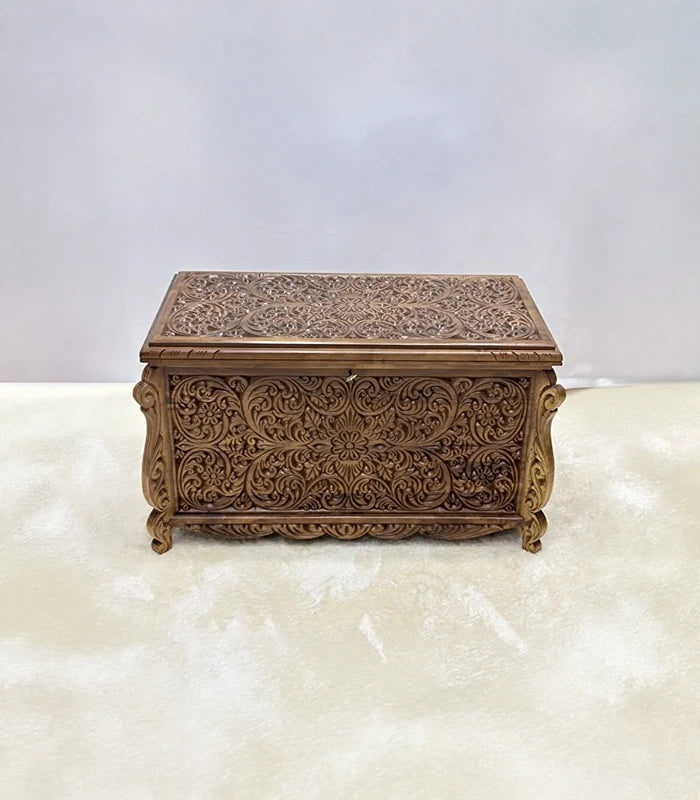
The Anatolian Sandık: A Hand-Carved Wooden Chest for a Lifetime
The sandık held Anatolian households' linen, a bride's çeyiz and the family's keepsakes. Its story, the domed bombeli form, and how to choose a hand-carved walnut chest for your home.
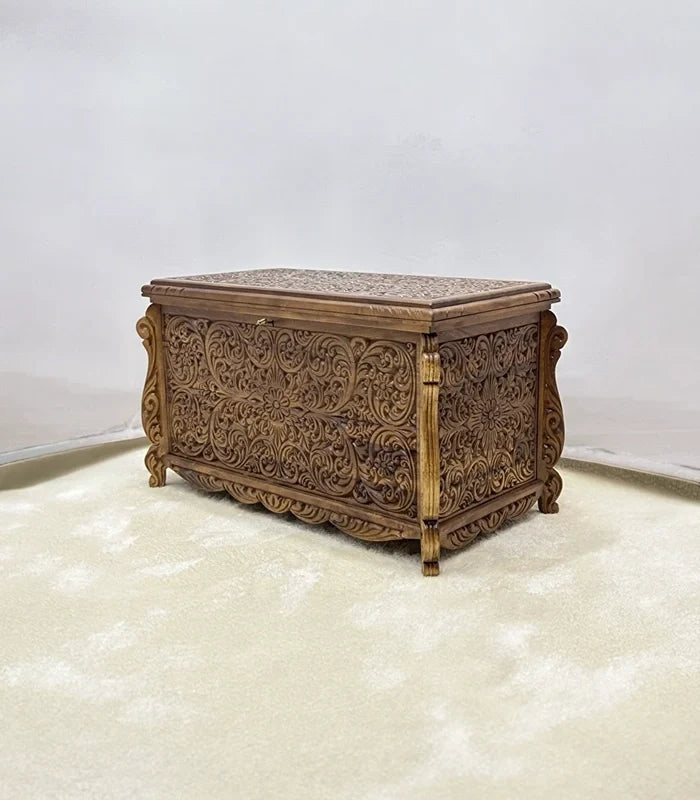
The sandık is the traditional Anatolian wooden chest: a lidded box of solid wood in which, for generations, households kept their linen and quilts, a bride's dowry (çeyiz) and the family's keepsakes. Ours are carved entirely by hand from solid walnut in Kahramanmaraş, in sizes from a 50 cm keepsake chest to a 95 cm chest for blankets.
This article explains what a sandık is, why it mattered so much in Anatolian homes, how the domed and flat forms differ, and how to choose the right size for a modern American house. Every chest mentioned is part of Edition II, the Maraş Edition, and every measurement comes from the piece itself.
What is a sandık?
Sandık is simply the Turkish word for a chest or trunk: a box with a hinged lid, made to store and protect what matters. In Anatolia the word carries more weight than that, because the chest was one of the most important pieces of furniture a household owned.
In many traditional Anatolian homes, rooms were used flexibly. The same room might serve for sitting by day and sleeping by night, so bedding was folded and put away each morning in built-in cupboards and chests. A good sandık kept quilts, linen and clothing clean, dry and out of the way. It was furniture that worked hard, and families looked after it accordingly.

Chests like these were made in many materials and many regions. Kahramanmaraş, a city in southeastern Türkiye, is known for its walnut carving, and the sandık is the piece its workshops are best known for. Every chest in our collection of hand-carved walnut chests comes from those workshops.
Why is the sandık tied to the dowry, or çeyiz?
The sandık is tied to the dowry because, traditionally, it was the container in which a bride's çeyiz was gathered and carried to her new home. The chest itself became a symbol of the marriage and of the household about to begin.
A çeyiz was, above all, textiles: embroidered linens, lace, towels, headscarves, needlework and bedding, often prepared over years by the bride, her mother and the women of the family. In many regions, the çeyiz was laid out for relatives and neighbors to admire before the wedding, and then packed into the chest. Customs varied from village to village and have changed a great deal, so it is fair to say the details differed while the idea stayed the same.
American readers will recognize the same instinct in the hope chest: a chest filled with linens and household things in anticipation of marriage, then kept for a lifetime. The sandık and the hope chest grew up in different places, but they answer the same human wish to prepare carefully for a new life.
What did families keep in a sandık?
Families kept whatever needed protecting: bedding and quilts, linen, clothing for special occasions, documents, letters, photographs and small valuables. Larger chests held the bulky things; small ones held the precious ones.
Some chests had locks, which made them the natural place for documents and small valuables. Our Ece 50 keepsake chest and its sisters at 50 cm wide are sized, as their descriptions put it, for letters, photographs, jewelry and keepsakes. Our larger chests have a generous interior for linen, quilts, blankets and keepsakes, which is the sandık's oldest job.


Today the uses are much the same. People use a sandık for spare quilts in a guest room, for a baby's first clothes and cards, for the letters and photographs of a family history, or for a wedding dress and the things that go with it.
Why are sandık chests made from walnut?
Walnut is a classic choice for a carved wooden chest because it is dense and fine-grained enough to hold sharp carved detail, stable once properly dried, and beautiful in color. Kahramanmaraş has carved walnut for generations, and the wood is part of the region's identity.
Several of our largest chests are made of solid kiln-dried walnut. Kiln-drying brings the wood to a stable moisture content before carving, which helps a large panel stay flat and a lid stay true over years. Every chest is cut from solid walnut, not veneer over board, and carved by hand with chisels, so the pattern on yours was made by a person and no two are exactly alike. Our explainer on solid walnut versus MDF and veneer shows how to tell the difference in any piece of furniture.
Many of the chests come in two finishes. Natural shows the walnut in its own warm color. Antique, called eskitme, is darkened by hand so the shadows of the carving stand out, for an heirloom look. The Aliye 95 chest, with dense traditional carving across the front, lid and sides, is offered in both.
Flat or domed: what is the bombeli form?
The domed form, called bombeli, has a gently curved body and lid instead of a flat top. It is one of the traditional sandık shapes, and it gives the chest a softer, more sculptural presence in a room.
The choice is partly practical. A flat lid gives you a usable surface for a folded throw, a tray or a lamp, which matters when the chest sits at the foot of a bed or beside a sofa. A domed lid sheds anything placed on it, so it works best where the chest is meant to be looked at: in an entry, under a window, or against a wall where the curve can be seen in profile. If you want a chest that doubles as a table, the lift-top Hazne tables in our guide to choosing a walnut coffee table combine both.

Our domed chests include the Erva 63 and 92, the Aliye 63 and 92, and the Hayat Ağacı 50 Domed and 95 Domed. The rest of the collection uses a flat hinged lid.
How do you choose the right size wooden chest?
Choose the size by what will go inside and where the chest will stand. Measure the space first, then think about contents: letters and photographs need a 50 cm keepsake chest; quilts and blankets need a 68 cm chest or larger.
| Size class | Example | Dimensions (W × D × H) | Good for |
|---|---|---|---|
| Keepsake | Papatya 50, Sarmaşık 50, Ece 50 | 50 × 30 × 30 cm (19.7 × 11.8 × 11.8 in) | Letters, photos, jewelry, a dresser top |
| Keepsake, taller | Hayat Ağacı 50 | 50 × 32 × 37 cm (19.7 × 12.6 × 14.6 in) | Keepsakes, a bookshelf or side table |
| Small domed | Erva 63, Aliye 63 | 63 × 39 × 45 cm (24.8 × 15.4 × 17.7 in) | An entry, a child's room, a throw or two |
| Medium | Papatya 68, Sarmaşık 68, Meriç 68 | 68 × 40 × 48 cm (26.8 × 15.7 × 18.9 in) | A twin bed, a reading corner |
| Large | Sultan 83, Hayat Ağacı 83 | 83 × 43 or 48 × 57 cm (32.7 × 16.9 or 18.9 × 22.4 in) | A full bed, a living room wall |
| Grand | Ece 95, Leyla 95, Papatya 95 | 95 × 50 × 60 cm (37.4 × 19.7 × 23.6 in) | A queen or king bed, quilts and blankets |
For a chest at the foot of a bed, width matters most. Our guide to blanket chests at the foot of the bed works through twin, full, queen and king beds in inches, including how much walkway to leave.
Hand-carved sandık chests to consider
These eight show the range of the collection, from small to grand, flat to domed. Each is solid walnut, carved by hand in Kahramanmaraş.

Ece 95 — hand-carved walnut chest with lock and key
The Ece pattern re-draws traditional Maraş motifs and carries them across the front, lid and sides. It is one of only two chests in the collection with a lock, and it comes with a key: the classic sandık for a dowry or family archive.
Solid kiln-dried walnut · 37.4 × 19.7 × 23.6 in · Natural or Antique finish
See the Ece 95
Hayat Ağacı 95 Domed — Tree of Life chest
The Tree of Life, with branches, leaves and roots, carved across the front of a full-size domed body. A natural choice for a wedding or a new home, since the motif is so often read as family and continuity.
Solid walnut · 37.4 × 19.7 × 21.3 in · bombeli domed form
See the Hayat Ağacı 95 Domed
Aliye 63 Domed — compact domed chest with lock
Dense hand-carved Maraş motifs across the front and lid, a domed body and a hinged lid with a lock. Small enough for an entry or a child's room, generous enough for a quilt.
Solid walnut · 24.8 × 15.4 × 17.7 in · Natural finish
See the Aliye 63 Domed
Erva 92 Domed — large domed chest
Among the tallest chests in the collection, with dense Maraş motifs across the front and lid. It works best against a wall or in an entry, where its curved profile can be seen.
Solid walnut · 36.2 × 19.3 × 24.8 in · Natural finish
See the Erva 92 Domed
Sultan 83 — chest with dense symmetrical carving
Dense, symmetrical traditional motifs carved across the front, in a size between the medium and grand chests. A good fit at the foot of a full-size bed.
Solid walnut · 32.7 × 16.9 × 22.4 in · flat hinged lid
See the Sultan 83
Papatya 68 — daisy chest
Hand-carved daisies set symmetrically across the front, in the Natural finish that shows the walnut's own color. Lighter in mood than the denser patterns, and easy to place in a modern room.
Solid walnut · 26.8 × 15.7 × 18.9 in · Natural finish
See the Papatya 68
Sarmaşık 50 — ivy keepsake chest
A climbing ivy vine carved across the lid and front, in the Antique finish. Sized for letters, photographs and keepsakes, it makes a meaningful gift for a couple.
Solid walnut · 19.7 × 11.8 × 11.8 in · Antique finish
See the Sarmaşık 50
Hayat Ağacı 50 — Tree of Life keepsake chest
The Tree of Life in keepsake size, a little taller than the 30 cm high keepsake chests. A fine first sandık for a newborn's keepsakes or a family's letters.
Solid walnut · 19.7 × 12.6 × 14.6 in · hinged lid
See the Hayat Ağacı 50What do the carved patterns on a sandık mean?
The carving on a sandık draws on a shared Anatolian vocabulary: the Tree of Life, daisies, ivy, Ottoman-inspired florals and dense scrolling ornament. Each carries associations, though readings vary from family to family.

The Tree of Life is commonly read as family and continuity, which suits a chest meant to be handed down. The ivy is linked with loyalty and endurance; the daisy with freshness and simplicity. Ottoman-inspired designs such as the İstanbul 95 chest borrow the symmetry and curving lines of Ottoman court ornament.
Our guide to Anatolian carving motifs explains each one in more depth.
How do you care for a wooden chest and what is inside it?
Care for a walnut chest is simple: dust the carving with a soft, dry brush, keep the chest out of prolonged direct sun and away from radiators, and avoid standing it in a damp basement or against a cold exterior wall where moisture collects.
For the contents, a few habits keep textiles in good condition. Store linen and quilts clean and fully dry. Wrap delicate pieces in clean cotton or acid-free tissue rather than plastic, which can trap moisture. Open the chest and air the contents now and then. Walnut is not cedar and is not known as a moth repellent, so if moths are a concern, add cedar blocks or lavender sachets inside.

Do not overfill the chest so the lid has to be forced closed, and lift the lid by its edge rather than by a carved projection. Treated this way, a solid walnut sandık should serve for decades, and its color will deepen and warm as it ages.
Is a sandık a good gift?
A sandık is one of the most meaningful gifts you can give for a wedding, a new home, a birth or an anniversary, because it is literally made to hold the things a family keeps. Wood is also the traditional gift for a fifth wedding anniversary.
A keepsake chest suits a couple or a new parent; a full-size chest suits a wedding or a first house. If you love the idea but want something smaller, the same tradition inspired our Sandık walnut watch box in Edition I, the chest reimagined for watches and ready to be engraved.
For more ideas, see our guide to luxury handmade gifts.
You can also browse the whole of Edition II, the Maraş Edition, where the same workshops carve tables, wall shelves and tesbih boxes.
Frequently asked questions
What does sandık mean?
Sandık is Turkish for chest or trunk. In Anatolian homes it was the wooden chest in which a household kept linen, quilts, a bride's dowry (çeyiz) and family keepsakes.
Is a sandık the same as a hope chest?
They are close cousins. Both are chests filled with linens and household things in anticipation of marriage and kept for a lifetime. The sandık comes from Anatolian tradition, while the hope chest is the name more familiar in the United States.
Do your wooden chests lock?
Some do. The Ece 95 has a hinged lid with lock and key, and the Aliye 63 Domed has a hinged lid with a lock. The other chests have a hinged lid without a lock, so check each product page.
What is the difference between the flat and domed chests?
Domed chests use the traditional bombeli form, with a curved body and lid. A flat lid gives you a usable surface for a throw or tray; a domed lid is more sculptural and best where it can be seen in profile.
What size wooden chest do I need for quilts and blankets?
Choose a chest 63 cm (24.8 in) wide or more; these are described as having a generous interior for linen, quilts and blankets. The 50 cm keepsake chests are sized for letters, photographs, jewelry and keepsakes.
From the Anatolia Editions workshop. We make watch boxes, valet trays and carved walnut furniture by hand in Türkiye, with two family workshops: one for joinery, one for Kahramanmaraş carving. More from the Journal