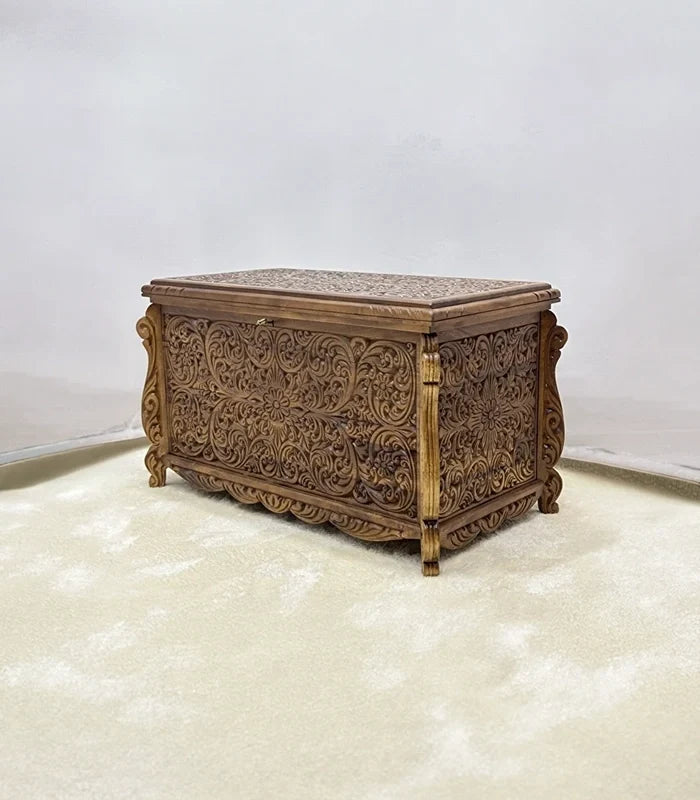
Blanket Chests: Ideas for the Foot of the Bed
How wide, how tall and how far from the bed: a practical guide to the blanket chest at the foot of the bed, with US bed sizes in inches and hand-carved walnut chests from Kahramanmaraş.
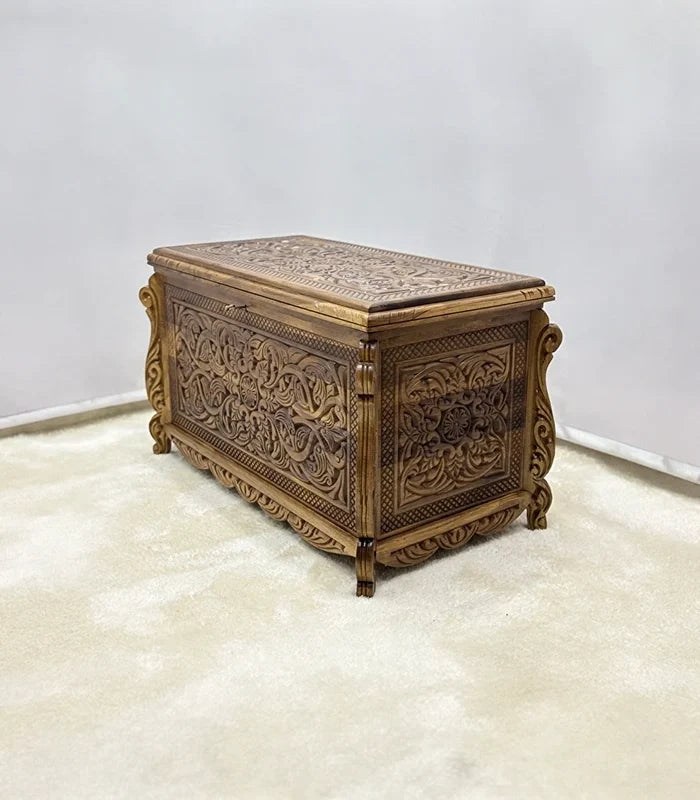
A blanket chest at the foot of the bed should be narrower than the mattress, at or a little below its height, and leave about 30 to 36 in of walkway beyond it. For a queen bed (60 in wide), a chest about 37 in wide, like our 95 cm hand-carved walnut chests, is a natural fit.
Below we work through every standard American bed size in inches, then cover height, clearance, flat versus domed lids, what to store and how to style the chest so it looks like it has always been there. The chests themselves are Edition II pieces, carved entirely by hand from solid walnut in Kahramanmaraş, a city in southeastern Türkiye known for its walnut carving. In Anatolia this kind of chest is called a sandık, and it has kept households' linen and quilts for generations.
What size blanket chest fits the foot of the bed?
A blanket chest usually looks best at roughly two-thirds to three-quarters of the bed's width. That leaves a few inches of bed on each side, so the chest reads as deliberate and the bedding can fall naturally at the corners.
Here is how our chest widths line up with the standard US mattress widths:
| Bed (mattress width) | Two-thirds to three-quarters | Our chests that fit |
|---|---|---|
| Twin (38 in) | about 25 to 29 in | 63 cm domed (24.8 in) or 68 cm (26.8 in) |
| Full (54 in) | about 36 to 41 in | 83 cm (32.7 in), 92 cm domed (36.2 in) or 95 cm (37.4 in) |
| Queen (60 in) | about 40 to 45 in | 95 cm (37.4 in) or 92 cm domed (36.2 in) |
| King (76 in) | about 51 to 57 in | a 95 cm chest centered, or a pair of 63 or 68 cm chests |
Treat the ratio as a guide rather than a rule. On a full bed, the 83 cm chests sit a little under two-thirds and look tidy and compact; the 95 cm chests sit just under three-quarters and feel more generous. On a queen, our 95 cm chests come in slightly under two-thirds, which is the proportion most people find comfortable in a bedroom, because it keeps the corners of the bed clear for walking past.

What about a king bed?
A king is the one size where you have a real choice. At 76 in wide, two-thirds would be about 51 in, wider than any single chest we make, so you can either center one large chest or set two smaller chests side by side.
A single 95 cm (37.4 in) chest, centered, covers about half the width. It looks calm and uncluttered, especially with a deep footboard or a bed skirt behind it. Two 63 cm domed chests side by side, with a gap of 2 to 4 in between them, span roughly 52 to 54 in; two 68 cm chests span roughly 56 to 58 in. A pair gives a king bed the presence it needs, and each side of the bed gets its own storage.
Pairs work best when the chests match. The Aliye 68 chest, in the Antique finish, or two of the domed Erva 63 chests make good pairs.
How tall should a blanket chest be?
A blanket chest should sit at or a little below the top of the mattress. If it rises above the mattress it starts to compete with the bed; if it sits far below, it can look lost.
Mattress heights vary widely with the frame, the box spring and the mattress thickness, so measure from the floor to the top of your mattress before you choose. Our full-size chests run from 45 cm (17.7 in) for the 63 cm domed chests to 63 cm (24.8 in) for the 92 cm domed chests:
- Low platform beds: the 68 cm chests at 48 cm (18.9 in) or the 63 cm domed chests at 45 cm (17.7 in).
- Standard frames: the 83 cm chests at 57 cm (22.4 in), the 95 cm chests at 60 cm (23.6 in) or the 95 cm domed chest at 54 cm (21.3 in).
- Tall beds: the 92 cm domed chests at 63 cm (24.8 in).
If the bed has a footboard, keep the chest lower than its top edge so the footboard still reads as part of the bed.
How much space do you need around a blanket chest?
Plan for three things in a line from the end of the bed: a small gap, the chest's depth, and a walkway. Together they tell you whether a chest fits the room.
- The gap: 2 to 4 in between the bed frame or footboard and the back of the chest, so the lid can swing open without scraping the bedding or the footboard.
- The chest: our 95 cm chests are 50 cm (19.7 in) deep; the 68 cm chests are 40 cm (15.7 in) deep.
- The walkway: about 30 to 36 in clear in front of the chest, which also gives you room to stand while you lift the lid.
So for a 95 cm chest, allow roughly 52 to 60 in from the end of the bed frame to the wall or dresser opposite. For a 68 cm chest, roughly 48 to 56 in. If you have less, choose a shallower chest, or move the chest to another wall. Mark the footprint with painter's tape and walk around it for a day before you order. If floor space is tight, our smaller Papatya 50 keepsake chest fits on a bench or dresser instead.

Flat lid or domed: which is better at the foot of the bed?
A flat lid is more useful at the foot of a bed; a domed lid is more decorative. If you want to lay a folded throw, set down a tray in the morning or put tomorrow's clothes out, choose flat.
The domed form, called bombeli in Turkish, is one of the traditional sandık shapes. Its curved lid sheds anything placed on it, so it works best where it can be seen rather than used as a surface: at the foot of a four-poster, in a guest room, or under a window. Our domed chests are the Erva 63 and 92, the Aliye 63 and 92, and the Hayat Ağacı 50 Domed and 95 Domed.
Carving also matters here. Some chests are carved across the front, lid and sides; others are described as carved across the front. If you plan to use the top as a surface, look for a front-carved chest and check the photographs to see how the lid is finished.
Can you sit on a blanket chest?
Many blanket chests double as benches, but ours are made as carved storage chests rather than seats, and a carved walnut lid is not a cushion. If you want somewhere to sit and pull on shoes, add a chair beside the chest instead.
For other seating and bedroom pieces, our walnut tables and furniture are carved in the same Kahramanmaraş workshops.
The Seyyah folding walnut chair, carved with classic Ottoman-style ornament on its backrest, folds flat to store and is as decorative against a bedroom wall as it is useful when you need a seat.
What should you store in a blanket chest?
Store the bedding you do not need every night: spare quilts and comforters, a winter blanket in summer, guest linens, throws and seasonal pillow covers. That was the sandık's job in Anatolian homes, and it is still the best use of a chest at the foot of the bed.
Our larger chests are described as having a generous interior for linen, quilts, blankets and keepsakes. To keep textiles in good condition, store them clean and fully dry, wrap delicate pieces in cotton or acid-free tissue rather than plastic, and air the contents now and then. Walnut is not cedar, so if moths are a concern, add cedar blocks or lavender sachets inside.
Blanket chest ideas by bed size and room
These eight chests cover the common bed sizes and moods. Each is solid walnut, carved by hand, with a hinged lid. For the full range, browse our hand-carved walnut chests.

Hayat Ağacı 95 — Tree of Life chest for a queen bed
The Tree of Life carved across the front and lid, in solid kiln-dried walnut. The motif is so often read as family and continuity that it belongs naturally at the foot of the bed in a primary bedroom.
37.4 × 19.7 × 23.6 in · queen or full bed · hinged lid
See the Hayat Ağacı 95The Tree of Life is one of several motifs with a long history in Anatolian carving; our guide to Anatolian carving motifs explains what each one is usually taken to mean.

Sarmaşık 95 — ivy chest for a couple's bedroom
A climbing ivy vine carved across the front. Ivy is commonly linked with loyalty and endurance, a fitting image at the foot of a shared bed.
37.4 × 19.7 × 23.6 in · Natural or Antique finish
See the Sarmaşık 95
Leyla 95 — Ottoman floral chest
Ottoman-inspired floral motifs carved symmetrically across the front. Its formal, balanced pattern suits a traditional bedroom with layered textiles.
37.4 × 19.7 × 23.6 in · Natural or Antique finish
See the Leyla 95
Papatya 95 — daisy chest
Hand-carved daisies across the front, sides and lid. Lighter in mood than the denser patterns, it suits a guest room or a bright bedroom with white bedding.
37.4 × 19.7 × 23.6 in · Natural or Antique finish
See the Papatya 95
Sultan 83 — chest for a full bed
Dense, symmetrical traditional motifs carved across the front, in the in-between width that suits a full bed or a narrower queen room.
32.7 × 16.9 × 22.4 in · front-carved · hinged lid
See the Sultan 83
Hayat Ağacı 83 — Tree of Life for a full bed
The Tree of Life carved across the front and lid, at the 83 cm width. A little deeper than the Sultan 83, at 48 cm against 43 cm.
32.7 × 18.9 × 22.4 in · hinged lid
See the Hayat Ağacı 83
Meriç 68 — chest for a twin bed
Symmetrical floral motifs carved across the front, in the Natural finish. Its 18.9 in height suits a twin bed, a low platform bed or a teenager's room.
26.8 × 15.7 × 18.9 in · Natural finish
See the Meriç 68
Erva 63 Domed — small domed chest
Hand-carved Maraş motifs across the front and lid of a compact domed body. At the foot of a twin bed or in a child's room, it holds a quilt or two and reads as a small sculpture.
24.8 × 15.4 × 17.7 in · bombeli domed form · Natural finish
See the Erva 63 DomedHow do you style a blanket chest at the foot of the bed?
Style a blanket chest by keeping it simple and letting the carving show. A folded throw over one end of a flat lid, a small tray, or nothing at all is usually right; piles of pillows hide the work you are paying for.
Choose the finish against the bedding. The Antique finish, eskitme, is darkened by hand so the shadows of the carving stand out, and it looks rich against white or cream linen. Natural shows the walnut's own warm color and sits easily with gray, blue and green bedding.

Echo the walnut elsewhere in the room so the chest is not the only carved piece. A Kandil 46 low side table, made at sofa or bedside height, works as a nightstand.
For a dressing corner, the Gelin walnut vanity cabinet has nine compartments for make-up, jewelry and accessories; gelin means bride in Turkish.

Where else can a blanket chest go?
A blanket chest works almost anywhere you need storage with presence: in an entry for scarves and gloves, under a window in a living room for throws, at the end of a hallway for guest linens, or in a nursery for a baby's blankets and first clothes.
In a living room, a chest can stand in for a side table or sit against a wall as a focal piece. If you want a chest that is also a coffee table, the lift-top, lockable Hazne tables in our guide to choosing a walnut coffee table combine the two.

To understand the tradition behind these chests, from linen and quilts to the bride's çeyiz, read our story of the Anatolian sandık.
To see what else the Kahramanmaraş workshops make, from tables to wall shelves, browse Edition II, the Maraş Edition.
Frequently asked questions
What size blanket chest is best for a queen bed?
A queen mattress is 60 in wide, so a chest of roughly 37 to 45 in looks balanced. Our 95 cm chests are 37.4 in wide, and the 92 cm domed chests are 36.2 in wide.
What is the best blanket chest size for a king bed?
A king is 76 in wide, so two-thirds of its width (about 51 in) is more than any single chest we make. Center one 95 cm (37.4 in) chest for a calm look, or place two matching 63 or 68 cm chests side by side for more presence and storage.
How much space should be between the bed and a blanket chest?
Leave about 2 to 4 in between the bed frame or footboard and the chest so the lid can open freely. Then allow about 30 to 36 in of walkway in front of the chest.
Are your blanket chests solid wood?
Yes. Every chest is cut from solid walnut and carved by hand in Kahramanmaraş, and several of the larger chests are made of solid kiln-dried walnut. No two are exactly alike.
Do any of your chests have locks?
The Ece 95 has a hinged lid with lock and key, and the Aliye 63 Domed has a hinged lid with a lock. The other chests have hinged lids without locks.
From the Anatolia Editions workshop. We make watch boxes, valet trays and carved walnut furniture by hand in Türkiye, with two family workshops: one for joinery, one for Kahramanmaraş carving. More from the Journal