Watch Box vs Watch Winder vs Watch Roll: Which Do You Need?
A watch winder keeps automatics running, a watch roll protects watches on the move, and a watch box stores a collection at home. Here is an honest guide to which one you need, and when you need more than one.

A watch winder keeps automatic watches running while you are not wearing them, a watch roll protects a few watches when you travel, and a watch box stores and organizes a collection at home. Most people need a box first, a roll if they travel often, and a winder only for automatics they hate resetting.
The three get compared as if they were rivals, but they solve different problems. A winder is about keeping a movement running. A roll is about getting watches from one place to another without scratches. A box is about where a collection lives day to day, safe from dust and knocks and easy to choose from.
We make solid walnut watch boxes, display cases and stands, and we do not sell winders or rolls. So take this as a workshop's honest view: what each tool is good at, where it falls short, and how to decide what your own watches actually need.
What does each one actually do?
A watch box stores watches at rest, a watch winder moves them to keep them running, and a watch roll wraps them for transport. That single difference, rest, motion or travel, explains almost everything else about them.
| Watch box | Watch winder | Watch roll | |
|---|---|---|---|
| Main job | Store, protect and organize at home | Keep automatic watches wound and running | Carry watches safely when traveling |
| Typical capacity | From 2 to 30 or more | Usually 1 to 4 per unit, more in large cabinets | Usually 1 to 4 |
| Power needed | No | Yes, mains or batteries | No |
| Best for | Any collection, any movement type | Automatics with complications, or several worn in rotation | Trips, weekends away, moving watches between homes |
| Limitations | Does not keep automatics running | Pointless for quartz and hand-wound watches; some motor noise | Not designed for display or long-term storage |
What is a watch winder, and who needs one?
A watch winder is a small motorized cradle that turns an automatic watch at intervals, mimicking the wrist motion that winds its rotor, so the watch never stops. You need one only if you own automatic watches and stopping them is a real nuisance rather than a minor chore.
An automatic watch winds itself as you wear it. Take it off and it keeps running on its power reserve, commonly a couple of days for many movements and longer for some, then stops. For a simple time-only watch, restarting is easy: give it a few turns of the crown, set the time, put it on.
The case for a winder gets stronger as the watch gets more complicated. A perpetual calendar, an annual calendar or a moon phase can take real time and care to reset correctly once it has stopped. Keeping that watch on a winder means it is always ready, and you never have to fiddle with pushers and corrections on a Monday morning.
The fair case for a watch winder
- Convenience. Pick it up, put it on; the time and date are right.
- Complications. Calendars and moon phases stay set.
- Rotation. If you wear several automatics in turn, a winder keeps them all ready.
The honest drawbacks
- Not for every watch. Quartz watches run on a battery and hand-wound watches have no rotor, so a winder does nothing for either.
- Power and setup. A winder needs a power source and the right settings, usually the number of turns per day and the rotation direction recommended for the movement.
- Noise and space. Even quiet motors make some sound, which matters on a nightstand. Winders are also bulky for the number of watches they hold.
- Wear is debated. A running watch is a working watch, and watchmakers do not all agree on whether keeping an unworn watch running constantly is better or worse for it than letting it rest. Whichever view you take, servicing on schedule matters more.
For most people with one or two simple automatics, a winder is a luxury rather than a need. For the owner of a perpetual calendar, it can be the most useful accessory they own.

What is a watch roll, and when is it the right choice?
A watch roll is a soft, padded wrap, usually leather or fabric, that holds a few watches on cushions and rolls up to protect them in a bag. It is the right choice whenever watches leave the house.
Its strengths are portability and simplicity. A roll keeps cases from knocking against each other and against the zipper of a bag, and it takes up little more space than a sunglasses case. For a weekend away with a dress watch and a sports watch, it is hard to beat.
Its limits are the flip side. A roll offers little protection from crushing, gives no view of the collection and is fiddly to use every day. Left on a dresser as permanent storage, watches in a roll gather dust in the folds and are harder to choose between than in a box. Think of it as luggage, not furniture.
What is a watch box best at?
A watch box is best at protecting and organizing a collection where it lives most of the time: at home. It keeps dust off, keeps cases from touching, and puts every watch in view so you can choose quickly.
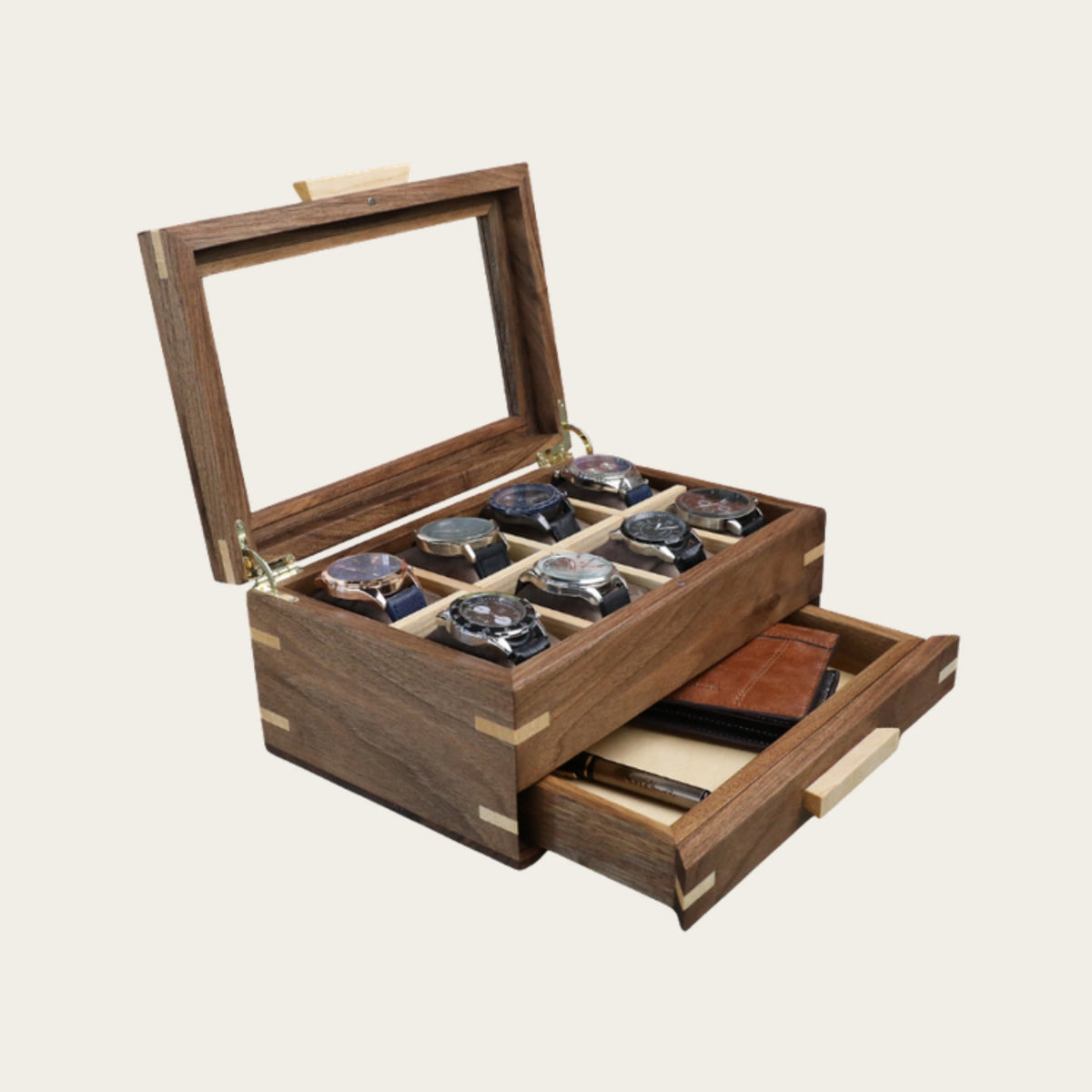
A good box also handles everything that gathers around a collection. On our Kervan walnut watch box with drawer, for example, the slots are cushioned, the lid stands upright on 90° hinges so you can choose with one hand, and the drawer below keeps straps, cufflinks, glasses and pens with the watches they belong to. It comes in capacities from 8 to 30.
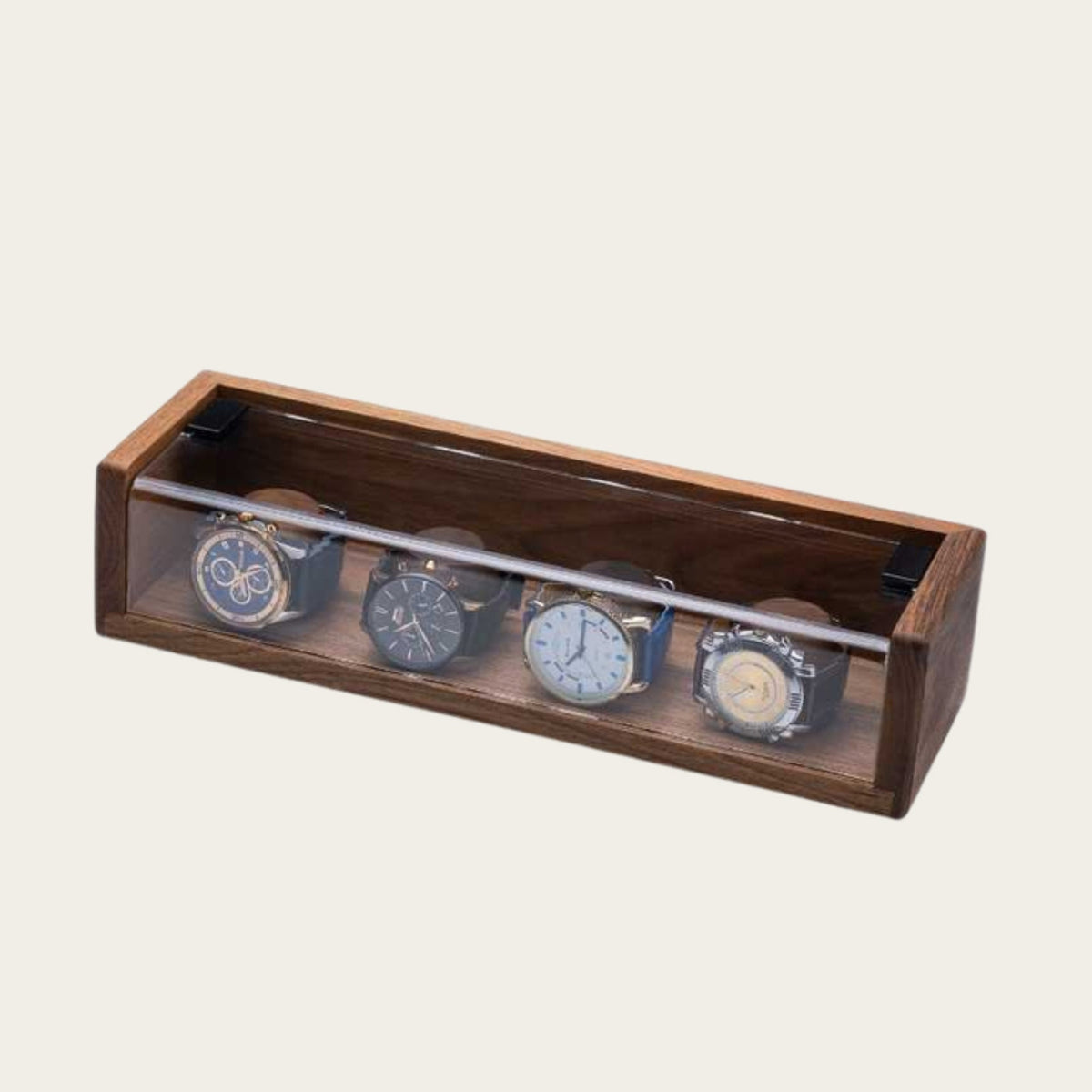
The lid changes the experience. A solid lid hides the collection; a glass or acrylic lid keeps it visible while still shutting out dust. The Efes walnut display case takes the second route: watches rest on turned walnut columns, 4.5 cm (1.8 in) in diameter, under 4 mm acrylic bent in one piece, in sizes from two watches to eight.
Our comparison of display cases and closed watch boxes goes into that choice in more depth.


What a box will not do is keep an automatic running. That is not a flaw; it is simply a different job. For a time-only automatic, the cost of storing it in a box is a few seconds of winding and setting when you next wear it.
Watch winder vs watch box: which should you buy first?
Buy a watch box first unless every watch you own is a complicated automatic. A box suits every movement type, needs no power and solves the storage problem for the whole collection; a winder solves one specific problem for a few watches.
Ask yourself three questions:
- How many of my watches are automatic? If the answer is none or one, a winder is unlikely to earn its place.
- Do any have complications I dread resetting? If yes, a single-watch winder for that piece makes sense, alongside a box for everything else.
- How many watches do I own, and how many will I own? This sets the size of the box. Our guide to choosing a watch box size covers it slot by slot.
What about watch stands and display cases?
Stands and display cases sit between a box and a winder: they hold watches at rest, like a box, but keep them in the open, ready to wear. For two or three watches in daily rotation, they are often the most practical choice of all.
A stand has no lid, or a light acrylic cover, so a watch goes on and comes off in a second. A display case adds a clear lid over a larger set. Neither keeps an automatic running, but both make it effortless to pick up the watch you want, which is half of what people hope a winder will do. You can see the options in our glass and acrylic display cases.
A practical tip if you go this route: set your automatics in the evening as you put them down, rather than in the morning rush. The few seconds of winding feel like part of a ritual rather than a chore.
How do collectors combine all three?
Most serious collectors end up with a box at home, a roll for travel and, sometimes, a winder for one or two pieces. The combination is less about buying everything and more about giving each watch the right place.
A typical arrangement looks like this. The collection lives in a box with enough slots and a drawer for straps and tools. The two or three watches in current rotation sit on a stand or bedside organizer, ready to wear. A perpetual calendar or a favorite automatic sits on a winder if the owner values never resetting it. And when he travels, a roll carries the trip's watches.
For the rotation, an open stand is often better than either a winder or a box. The Sütun 3 walnut watch stand holds three watches on turned columns, measures 33 × 8.5 × 7.5 cm (13 × 3.3 × 3 in), and takes an optional acrylic cover against dust.
On a nightstand, the Gece bedside organizer adds a column for glasses, two small dishes and an upright phone slot.

For larger collections, a box with a drawer keeps spare straps, tools and travel accessories in one place. The Kervansaray 24 collector's box has spacious slots so larger cases and bracelets fit without crowding, plus a deep drawer for accessories measuring 24 × 22 × 6.5 cm (9.4 × 8.6 × 2.6 in).

Which do you need? A quick guide by owner
- Quartz and hand-wound watches only: a watch box or stand. A winder does nothing for these movements.
- One or two simple automatics: a box or stand; reset the time when you wear them. Add a roll if you travel.
- An automatic with a calendar or moon phase: a single winder for that watch, plus a box for the rest.
- Frequent traveler: a roll for the road and a box at home, ideally one with a drawer for travel accessories.
- Growing collection: a box with room to grow. You can see every size we make in our solid walnut watch boxes.
If you are weighing lids, drawers and capacity, our guide to how to choose the best watch box goes through each decision in turn.
Whatever you choose, buy for the material as much as the format. A box that will be opened every day for decades should be solid wood with real joinery; here is how to tell solid walnut from MDF and veneer.
Frequently asked questions
Do I need a watch winder for an automatic watch?
No. An automatic watch stops when its power reserve runs out, but it is not harmed by stopping. You simply wind and set it when you next wear it. A winder is a convenience, most useful for watches with complications such as calendars or moon phases.
Can I use a watch winder with a quartz watch?
There is no point. Quartz watches are powered by a battery and hand-wound watches have no rotor, so a winder does nothing for them. Store them in a box or on a stand instead.
Is a watch roll good for storing watches at home?
It works, but it is not ideal. A roll is designed for travel, so it gives no view of your collection and collects dust in its folds. At home, a box or display case protects watches better and makes choosing easier.
Do you sell watch winders or watch rolls?
No. We make solid walnut watch boxes, display cases, watch stands and bedside organizers, and hand-carved collector's boxes. A winder or roll from a specialist can sit happily alongside one of our boxes.
Will a watch box fit large watches?
It depends on the box. Our Kervansaray 24 has spacious slots so larger cases and bracelets fit without crowding, and the Sandık Heirloom is slightly taller for chunkier cases. On column displays, the standard 4.5 cm (1.8 in) column suits most men's watches.
From the Anatolia Editions workshop. We make watch boxes, valet trays and carved walnut furniture by hand in Türkiye, with two family workshops: one for joinery, one for Kahramanmaraş carving. More from the Journal